


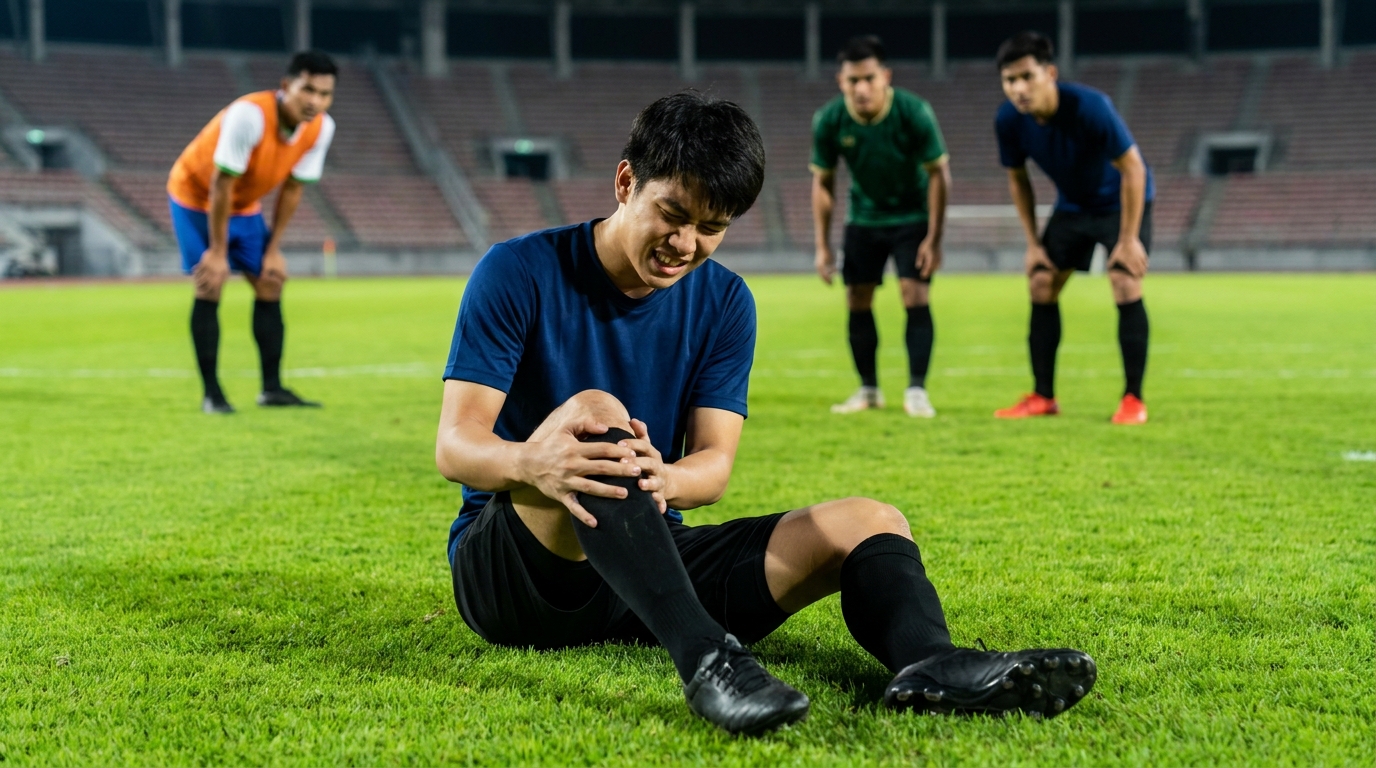
A knee pop while playing football or soccer can be caused by an ACL tear, a meniscus tear or another knee injury. Stop playing if it is followed by pain, swelling, instability, locking or difficulty moving the knee.
Being able to walk or having little swelling does not rule out injury. Persistent symptoms should be checked before returning to play.
What Does a Knee Pop During Football Mean?
A sudden knee pop during football is different from the painless clicking some people notice during normal movement.
It may happen when your foot stays on the ground while your body turns, or during a sudden change of direction, awkward landing or tackle.
These movements can damage a ligament, the meniscus, cartilage or the patella (kneecap). However, the sound alone cannot tell you exactly what was injured. How the injury happened and the symptoms that follow can provide important clues.
Could the Pop Be an ACL or Meniscus Tear?
An ACL tear and a meniscus tear can both happen when the knee twists during football. Their symptoms can feel similar, and both injuries may occur at the same time.
How an ACL Tear May Happen
The anterior cruciate ligament, or ACL, helps keep the knee stable when you stop, turn or change direction.
An ACL tear may happen when you:
- Turn sharply with one foot planted
- Stop or slow down suddenly
- Land awkwardly after a jump
- Twist the knee during a tackle
You may hear or feel a pop when the injury happens. The knee may give way, become painful or feel unstable when you try to turn or change direction.
Symptoms of a Meniscus Tear
The menisci are two pieces of cartilage that help cushion the knee. A meniscus may tear when the knee twists while your foot remains on the ground.
You may notice:
- Pain along the inner or outer side of the knee
- Catching during movement
- Difficulty fully straightening or bending the knee
- A feeling that something is stuck inside the joint
A torn piece of meniscus can sometimes move out of position and block normal movement. This may cause the knee to become physically locked.
What Else Could Cause a Knee Pop?
A painful knee pop is not always caused by an ACL or meniscus tear.
Other possible causes include a patella dislocation, cartilage damage or an injury involving more than one part of the knee. A dislocated patella may look out of position, while cartilage damage may cause pain or make the knee feel stuck or difficult to move smoothly.
Because these injuries can cause similar symptoms, a physical examination may be needed to identify what was injured.
Can You Still Walk With an ACL or Meniscus Tear?
Some people can still walk after an ACL or meniscus tear.
An ACL injury may feel reasonably stable when you walk slowly in a straight line. However, the knee may give way or feel unsteady when you turn or change direction.
A meniscus tear may also allow you to walk at first. Pain, swelling, catching or difficulty straightening the knee may become more noticeable over the next few hours or days.
Being able to walk does not mean the injury is minor or that it is safe to continue playing football.
Knee Popped but No Swelling: Could It Still Be Serious?
A lack of swelling does not rule out an ACL, meniscus or other knee injury.
An ACL tear often causes swelling within the first few hours, although this may be less obvious with a partial tear.
Swelling from a meniscus injury may develop more slowly. Some people notice increasing tightness or reduced movement later that day or over the next few days.
Do not judge the injury based on swelling alone. A knee that gives way, locks, becomes more painful or is difficult to move should be checked.
What Should You Do After Your Knee Pops?
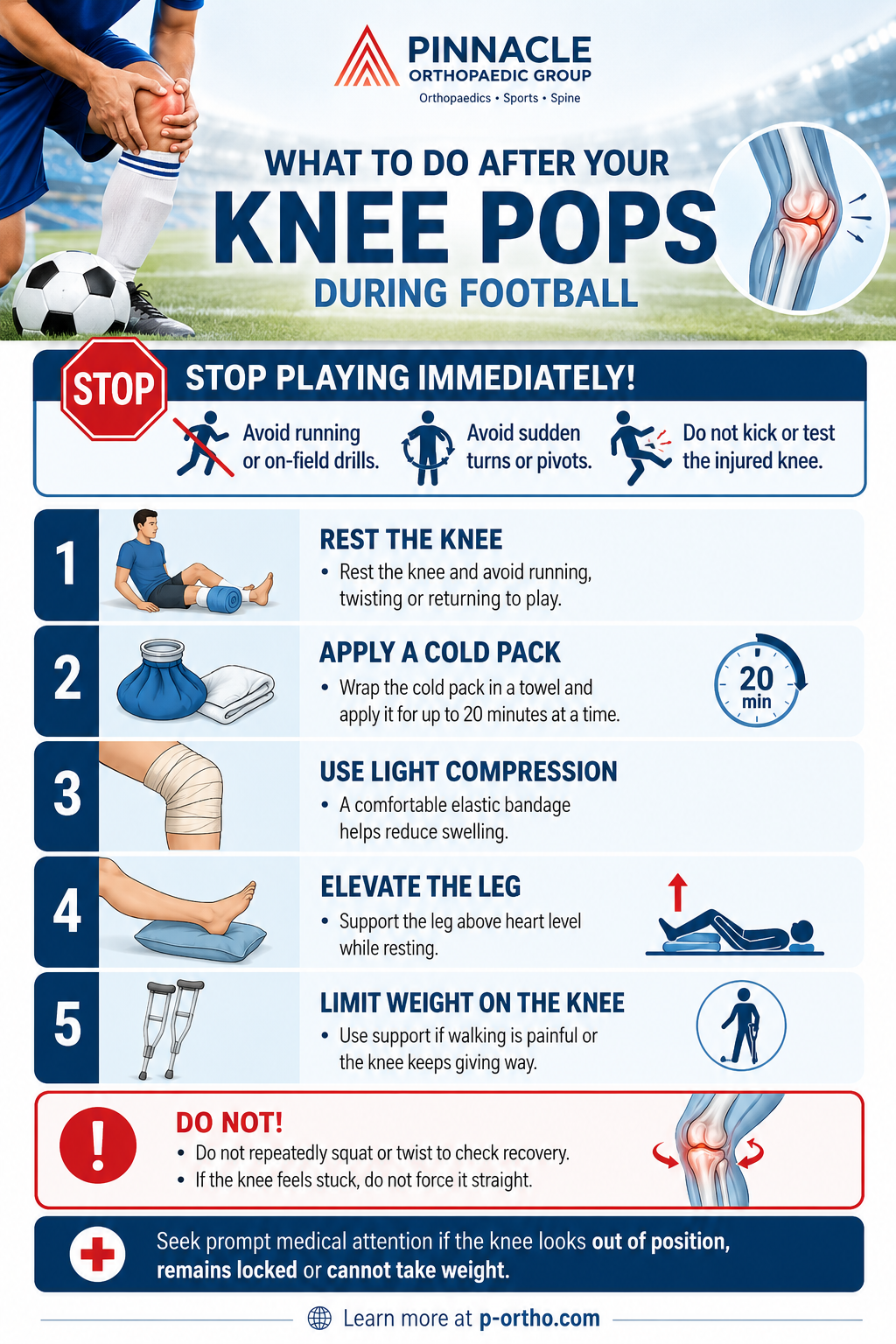
Stop playing and avoid running, turning, kicking or testing the injured knee.
After the injury:
- Rest the knee. Avoid running, twisting or returning to play.
- Apply a cold pack. Wrap it in a towel and apply it for up to 20 minutes at a time.
- Use light compression. A comfortable elastic bandage may help reduce swelling.
- Elevate the leg. Support it above heart level while resting.
- Limit weight on the knee. Use support if walking is painful or the knee keeps giving way.
Do not repeatedly squat or twist the knee to check whether it has recovered. If the knee feels stuck, do not force it straight.
When Should a Football Knee Injury Be Checked?
Have the knee checked if the injury is followed by swelling, instability, difficulty moving the knee or pain when putting weight on the leg.
Arrange an assessment if:
- You cannot put weight on the injured leg
- The knee repeatedly gives way
- Swelling continues to increase
- You cannot fully straighten or bend the knee
- The knee catches or becomes locked
- Pain is severe or getting worse
- The symptoms do not begin to improve
Seek prompt medical attention if the knee looks out of position, remains locked or cannot be moved.
How Is a Knee Injury Diagnosed?
Diagnosis usually starts with how the injury happened, the symptoms that followed and a physical examination. Depending on the findings, an X-ray or MRI may be recommended.
Knee Examination
The doctor may ask if the knee twisted, received a direct blow or gave way during the injury. They may also ask when swelling started and if the knee catches, locks or feels unstable.
During the examination, the doctor may check:
- Where the pain is located
- How much swelling is present
- How far the knee can bend and straighten
- How stable the knee feels
- Which movements cause pain or catching
These checks can help identify if the ACL, meniscus, patella or another part of the knee may be injured.
What Can an X-Ray Show?
An X-ray can show fractures and other injuries involving the bones around the knee.
However, it does not show the ACL or meniscus clearly. A normal X-ray therefore does not rule out a tear in either structure.
Do You Need an MRI for a Knee Injury?
Not every knee injury requires an MRI.
An MRI provides detailed images of the ligaments, menisci, cartilage and tendons. It may be recommended if the examination suggests an ACL tear, meniscus injury or damage to more than one part of the knee.
The need for an MRI depends on your symptoms, the examination findings and how the result may affect your treatment.
What Treatment May Be Needed After a Football Knee Injury?
Treatment depends on what was injured, the severity of the damage and how well the knee is moving and functioning.
Not every ACL or meniscus tear requires surgery. Early treatment may include avoiding football and twisting movements, managing pain and swelling, and following a physiotherapy programme to restore movement, strength and control.
For an ACL injury, surgery may be considered if the knee remains unstable or if you plan to return to sports that involve turning and pivoting.
Some meniscus tears can improve without surgery. Knee arthroscopy may be considered if pain continues or the knee repeatedly locks because torn tissue is blocking normal movement.
Consult an orthopaedic knee specialist for an assessment and advice on suitable treatment options.
When Can You Return to Football?
Return to football should be based on how well the knee has recovered, not simply because the pain has improved or you can jog in a straight line.
Football requires the knee to handle sudden stops, turns, jumps, landings and contact. Before returning, you should have regained:
- Full or near-full knee movement
- Strength in the injured leg
- Balance and control
- Stability when turning and changing direction
- The ability to complete football-specific movements safely
The timing depends on the injury, treatment and rehabilitation progress. Returning too early may cause the knee to give way or lead to further injury.
Frequently Asked Questions
Does a knee pop during football always mean an ACL or meniscus tear?
Not necessarily. A painful pop may also be caused by cartilage damage, a patella dislocation or another knee injury. An examination may be needed to identify the cause.
Can the ACL and meniscus tear at the same time?
They can. The same twisting movement may injure both the ACL and meniscus. Other parts of the knee may also be affected.
Can an ACL tear happen without a loud pop?
It can. Some ACL tears happen without an obvious sound. The knee may still become swollen, feel unstable or give way during turning and pivoting movements.
Getting Your Knee Checked After a Football Injury
Pain, swelling, instability, locking or difficulty moving after a football knee injury should not be ignored, even if you can still walk.
If your symptoms continue, consider arranging a detailed knee assessment with Pinnacle Orthopaedic Group.

About Our Doctor
Dr Kevin Lee
MBBS (Singapore), MMed (Singapore), MRCS (Edinburgh), FRCS (Edinburgh) (Orthopaedics)
Dr Kevin Lee is a US fellowship-trained senior consultant orthopaedic surgeon in Singapore who specialises in hip and knee surgery. He manages complex and revision joint replacements, lower limb sports injuries, and cartilage repair procedures, including stem cell–based treatments, with a focus on restoring movement and function.