


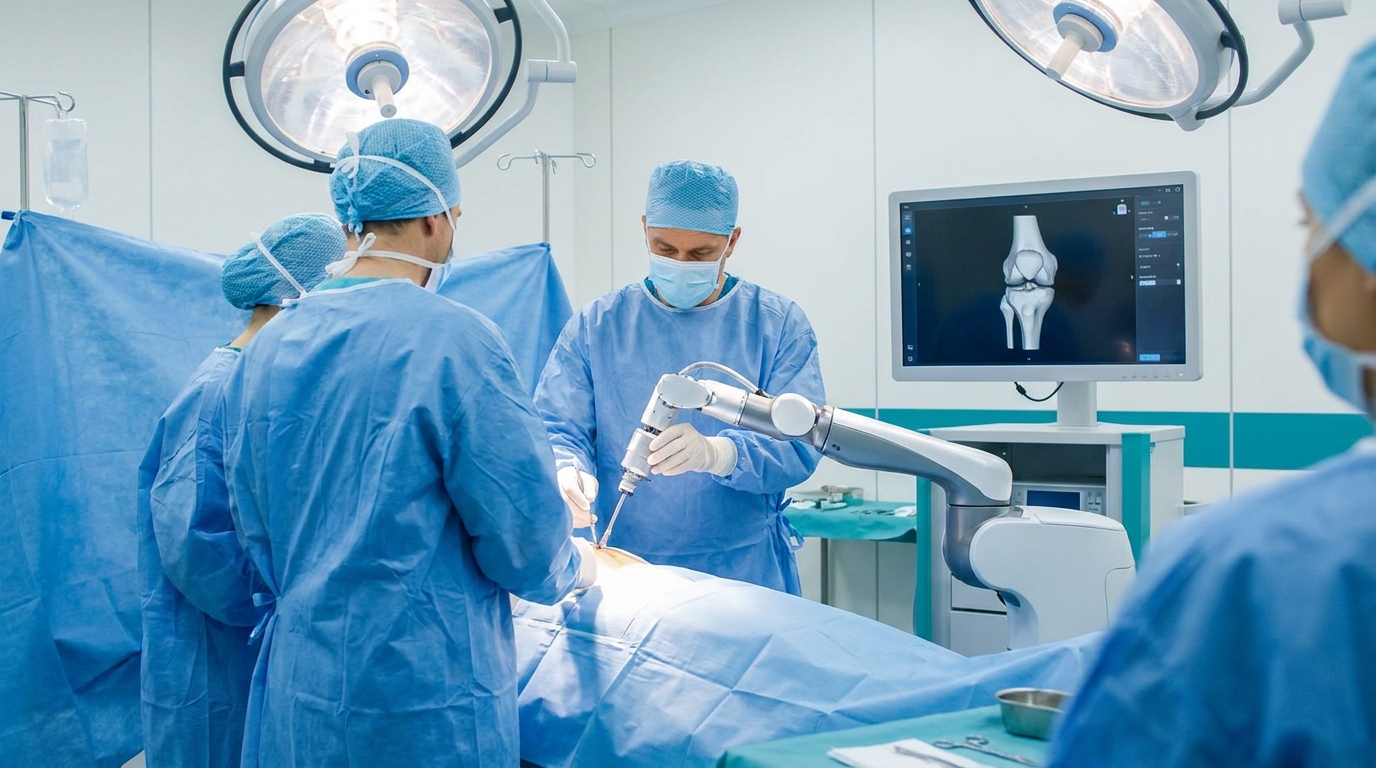
Robotic knee replacement uses imaging, planning software and robotic assistance to help surgeons plan knee replacement surgery according to the patient’s anatomy. It allows the surgeon to visualise the knee in detail, plan implant positioning and perform the procedure under direct, hands-on surgeon control.
During surgery, the robotic system provides real-time guidance to support accurate bone cuts, implant alignment and personalised knee balancing.
What Is Robotic Knee Replacement?
Total knee replacements have traditionally been performed using conventional surgical instruments that guide surgeons in making bone cuts to prepare the knee joint to receive the knee prosthesis.
Variations in patients’ anatomy can occasionally lead to inaccurate placement of knee implants. As such, various techniques such as patient-specific instruments and computer-aided surgery have been developed to help overcome these challenges.
One innovation in the field of knee replacement surgery is robotic knee replacement, which supports surgical planning, bone cut accuracy and implant positioning.
How Robotic Knee Replacement Works
When robotic knee surgery is utilised, imaging and planning software are used to generate a three-dimensional model of the knee before surgery. This allows the surgeon to visualise the patient’s anatomy and plan the procedure according to the individual joint structure.
Special trackers are then used in the operating room to help the robotic system monitor the position and movement of the knee in real time. Under direct, hands-on surgeon control, the robotic system assists with carrying out the planned bone cuts and implant placement.

Benefits of Robotic Knee Replacement
Robotic knee replacement may offer advantages in three main areas: accuracy of bone cuts, personalised knee balancing, and preservation of healthy tissue.
Enhanced Precision and Accuracy
With the aid of real-time tracking, the robotic system constantly monitors the position of the knee during surgery. This allows the robotic arm to position itself and provide a stable platform from which accurate bone cuts can be made.
This precision in bone cuts allows the surgeon to place the knee implants in the planned position. Precise alignment and accurate positioning of the implant are important in knee replacement surgery, as they are factors that can affect implant longevity.
Proper alignment reduces stress on the implant and may reduce the rate of wear and tear. Conversely, total knee components placed in suboptimal positions can experience accelerated wear and may result in the need for earlier revision knee surgery.

Personalised Knee Balancing
Every knee is different. The arthritic process can result in the contracture of some knee ligaments and the loosening of others.
Robotic knee replacement technology provides surgeons with real-time feedback about the state of the knee and its ligaments during each stage of the knee replacement procedure. Using this objective data provided by the robotic system, the surgeon can make adjustments and optimise the surgical plan.
The surgeon can also simulate various implant positions in the robotic system to determine which position may provide better alignment, knee balance and implant function.
Preservation of Healthy Tissue
Another advantage of robotic knee replacement is the preservation of healthy tissue where possible. The robotic system enables precise removal of the damaged parts of the knee joint while preserving healthy bone and ligaments as much as possible.
Excessive ligament releases may also be avoided in suitable cases. By reducing unnecessary surgical trauma, this may help lower inflammation, postoperative pain and recovery time in selected patients.
Robotic Knee Replacement Surgery
Robotic knee replacement surgery provides additional planning and intraoperative guidance for implant placement and knee balancing.
If you are considering knee replacement, consult your knee specialist to discuss the potential benefits of robotic knee replacement and whether it may be suitable for your condition.

Dr Alvin Tan Chin Kwong
Senior Consultant Orthopaedic Surgeon in Singapore
MBBS (Singapore), MRCS (Ireland), MMed (Orthopaedics) (Singapore), FRCS (Orthopaedics) (Edinburgh)
Dr Alvin Tan is a fellowship-trained orthopaedic surgeon in Singapore who specialises in hip and knee replacement surgery, including partial, total, revision, and robotic procedures. He focuses on minimally invasive techniques and recovery-centred care to help patients regain mobility and function.
Looking For A Reliable Knee Orthopaedic Specialist?
Fast Medical Attention, Transparent Fees
Make an appointment for comprehensive care for your knee problems!